
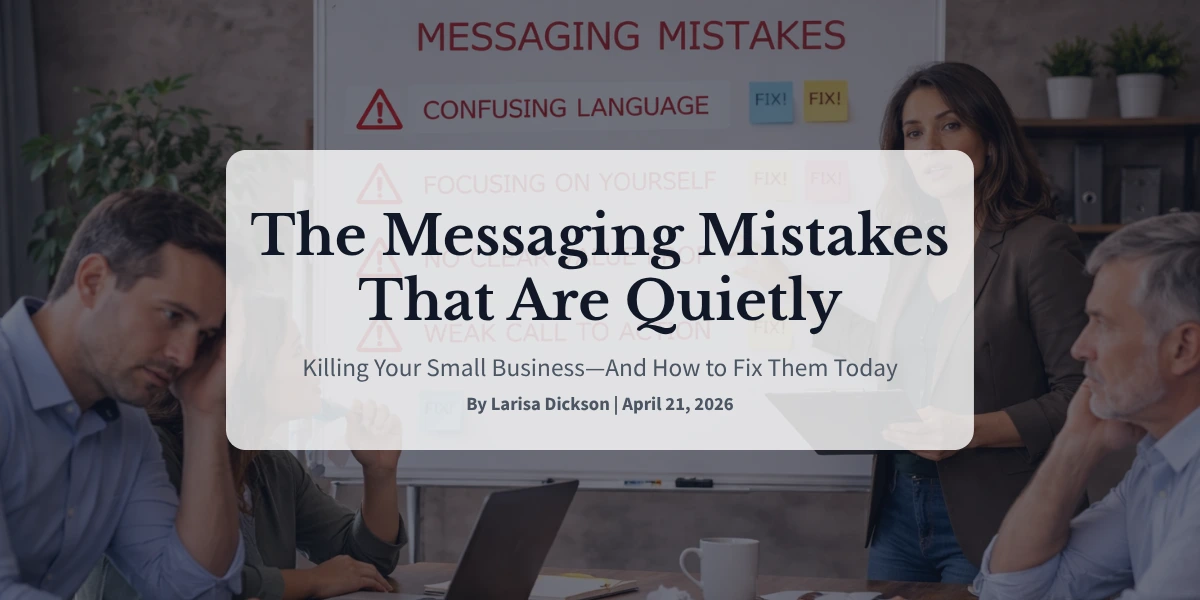
You’re not losing clients because your competition is better. Read that again.
You’re losing them because your message is making mistakes you don’t even realize you’re making. And the worst part? Nobody is going to tell you. Your prospects aren’t going to send you a polite email that says, “Hey, I visited your website and couldn’t figure out what you actually do, so I hired someone else.” They just leave. Quietly. And you’re left wondering why your pipeline is dry when you’re doing everything you’re supposed to be doing.
I’ve seen these same messaging mistakes sabotage talented business owners for nearly four decades. And the frustrating thing is they’re fixable—every single one of them. By the time you finish reading this, you’re going to know exactly which mistakes are costing you clients, why they’re so common, and how to correct them before another prospect slips through the cracks.
Mistake Number One: Talking About Yourself Instead of Your Client
This is the most common brand messaging mistake on the planet, and almost every small business owner is guilty of it at some point. You open your website, your About page, your social media bio—and the first thing you see is all about you. Your story. Your certifications. Your mission statement. Your values.
And I get it. You’re proud of what you’ve built. You should be. But your prospective client didn’t land on your page to learn about you. They landed there because they have a problem and they’re looking for someone who understands it.

What This Mistake Actually Costs You
Every second a visitor spends on your site trying to figure out how you can help them is a second closer to them clicking away. Attention online is measured in heartbeats, not minutes. If the first thing they see is your résumé instead of their pain point reflected back at them, the connection never forms. They don’t feel seen. They don’t feel understood. They leave.
I had a client named Kevin D. who ran a small IT consulting firm. His entire homepage was about his team’s credentials, their years of combined experience, their technology stack. Impressive stuff—to other IT professionals. But his ideal clients were small business owners who didn’t know a server from a router. They didn’t care about his certifications. They cared about one thing: will my systems stop crashing?
We flipped his homepage to lead with: “Tired of your technology failing you at the worst possible moment? We keep small businesses running so you can stop putting out fires and start growing.” His consultation requests increased within the first six weeks.
The Fix
Rewrite your homepage and social bios with your client as the hero, not you. The first thing anyone should read is a description of their problem and a promise of the solution. Your credentials come later—after you’ve already earned their attention.
Mistake Number Two: Being Vague Because You’re Afraid of Narrowing Down
This one is fear-based, and I see it constantly. Business owners keep their messaging broad because they’re terrified of excluding someone. “If I niche down, I’ll lose potential clients.” No. If you stay vague, you’ll lose all of them.
Vague messaging sounds like: “We help businesses grow.” Okay—what kind of businesses? Grow how? By doing what? A prospective client reads that and thinks, “That could be anyone,” and moves on to someone who sounds like they were built specifically for them.
Why Vagueness Feels Safe But Is Actually Dangerous
When your message is vague, you’re competing with everybody. Every coach, every consultant, every service provider who also “helps businesses grow” is now your competitor. But when you get specific—“I help women-owned service businesses generate their first six figures without burning out”—suddenly you’re in a category of one.
Cash is king, and vague messaging is one of the most expensive mistakes you can make because it forces you to spend more on ads, more on content, more on everything just to get noticed. Specificity is free and it works better than any ad budget.
The Fix
Answer this question honestly: if you could only work with one type of client for the rest of your career, who would it be? Now make your messaging speak directly to that person. You’re not excluding everyone else—you’re making the right person feel like you were put on this earth to help them. That’s a massive difference.
Mistake Number Three: Changing Your Message Every Time Something Doesn’t Work
This is the silent killer. Something doesn’t land—a post flops, a launch underwhelms, a networking event doesn’t produce leads—and immediately the instinct is to change the message. New tagline. New bio. New angle. New voice.
And every time you change, you reset the clock on trust. Because trust isn’t built the first time someone sees your message. It’s built the fifth time. The eighth time. The twelfth time. If your message changes every month, your audience never gets to the point where they trust it enough to take action.

The Real Reason You’re Tempted to Change
You’re bored with your own message. That’s it. You’ve said it so many times that it feels stale to you. But here’s what you’re forgetting: your audience hasn’t heard it as many times as you have. You might be on repetition number fifty. They might be on repetition number three. And they need at least five more before they act.
Learned behaviors can be unlearned. If you’ve trained yourself to pivot every time something doesn’t immediately work, you can retrain yourself to hold steady. Consistency isn’t boring. It’s strategic. And it’s the thing separating you from the business owners in your space who have built real brand recognition.
The Fix
Commit to your message for a minimum of ninety days before you evaluate it. Not ninety days of half-hearted use—ninety days of putting it front and center on every platform, in every conversation, in every piece of content. Then look at the data. If it’s not working after a real, consistent effort, adjust. But don’t confuse impatience with a messaging problem.

Bringing It All Together
These three mistakes—talking about yourself, being vague, and constantly changing your message—are the reason so many talented small business owners feel stuck. The good news is none of them require a massive overhaul to fix. They require honesty, specificity, and patience.
Make your client the hero. Get specific about who you serve and what you solve. And stay the course long enough for your message to actually do its job. I’ve watched this formula work across thousands of business owners and nearly four decades of building from the ground up. It’s not flashy. But it works every single time.
Your Next Step
Here’s what I want you to do right now. Pull up your website homepage and read the first three sentences out loud. Are they about you or about your client? If they’re about you, rewrite them today. Lead with the problem your client is facing and the solution you deliver.
Then check your last ten social media posts. Are they reinforcing the same core message, or are they scattered across five different topics? If they’re scattered, pick your one core message and commit to it for the next ninety days.
Long story short—the fix is simpler than you think. But simple doesn’t mean easy. It takes discipline. And if you need guidance, please reach out. I didn’t build a business serving over two thousand families by accident. I built it by getting my message right and keeping it right. I can help you do the same.