

You’re overthinking this. I know that sounds blunt, but somebody needs to say it to you.
You’ve been staring at your website copy, rewriting your Instagram bio for the fourteenth time, sitting in front of your laptop at eleven o’clock at night trying to figure out the perfect way to describe what you do. And every version you come up with either sounds too generic, too salesy, or too complicated for anyone to actually understand.
Meanwhile, your competitor—who you know is not as good as you—has a message so simple it could fit on a napkin. And they’re getting the clients. They’re getting the engagement. They’re getting the calls. And you’re sitting there wondering what they know that you don’t.
Here’s what they know: simple wins. Every single time. And by the end of this blog, you’re going to know how to strip your marketing message down to something so clear, so simple, and so effective that the right people can’t look away.
Complexity Is Not a Flex—It’s a Wall
Let me tell you something that took me years to learn. The smarter you are, the harder this is. Because smart people want to communicate the full depth of what they do. They want people to understand the nuance, the expertise, the layers of value they bring. And so they create marketing messages that are thorough, comprehensive, and completely ineffective.
Your audience doesn’t have time for thorough. They’re scrolling on their phone while waiting in a drive-through line. They’re scanning your website for three seconds before deciding whether to stay or leave. Three seconds. You don’t have time for nuance in three seconds. You have time for one clear idea.

What Complexity Really Costs You
I had a client named Renee W. who was a brilliant leadership coach. I mean genuinely brilliant—she had certifications, research backgrounds, frameworks she’d developed herself. Her website read like a graduate thesis. Every page was packed with methodology descriptions, proprietary models, and multi-paragraph explanations of her approach.
Nobody was booking. Not because her work wasn’t exceptional. Because her message required a master’s degree to understand.
We took everything she had and boiled it down to one sentence: “I help overwhelmed managers become leaders their teams actually want to follow.” That’s it. One line. Her bookings tripled in sixty days.
The agitation is real: every layer of complexity you add to your message is another reason for someone to click away. You’re not impressing anyone with big words and long descriptions. You’re exhausting them. And exhausted prospects don’t buy.
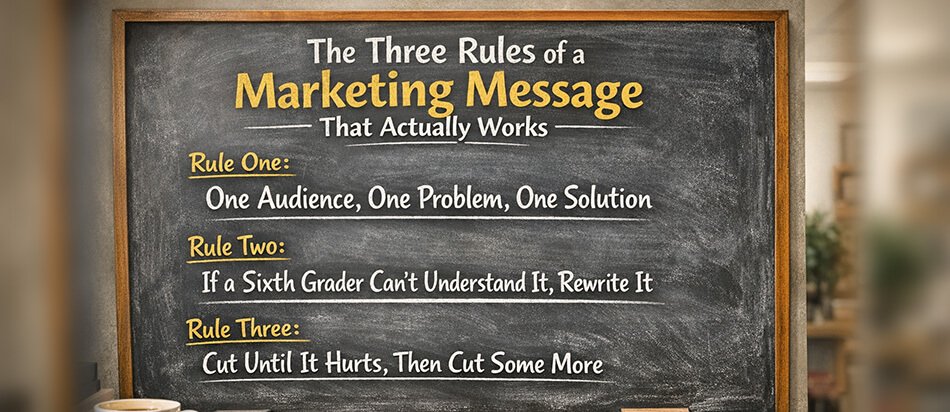
The Three Rules of a Marketing Message That Actually Works
Rule One: One Audience, One Problem, One Solution
Your message should do three things and three things only. Identify who you’re talking to. Name the problem they’re facing. And tell them what changes when they work with you. That’s the whole formula.
Not three audiences. Not five problems. Not a menu of solutions. One of each. The tighter the focus, the sharper the message. The sharper the message, the faster someone decides you’re for them.
I built my tax practice on this exact principle. I didn’t try to be a tax professional for everyone. I served families. Real families who needed someone who cared about their financial future. That clarity carried me through decades because the right people always knew exactly what I was about.
Rule Two: If a Sixth Grader Can’t Understand It, Rewrite It
This is the test I give every single coaching client and I’m giving it to you right now. Read your marketing message out loud. If a twelve-year-old couldn’t tell you back what you do after hearing it, your message is too complicated.
That doesn’t mean your work is simple. It means your explanation needs to be. The most sophisticated businesses in the world describe what they do in plain language. They don’t hide behind jargon because they don’t need to. Confidence sounds simple. Insecurity sounds complicated.
Cash is king, and clarity is what converts that attention into cash. When someone understands your message instantly, the path from “that’s interesting” to “take my money” gets dramatically shorter.
Rule Three: Cut Until It Hurts, Then Cut Some More
You know that paragraph on your website that explains your process in six steps? Cut it. That section where you list every service you offer? Cut it. That bio where you mention every certification, every award, every speaking engagement? Cut it.
I’m not saying those things don’t matter. I’m saying they don’t belong in your core marketing message. Your message is the front door. It gets people inside. Once they’re inside, you can show them the whole house. But if the front door is cluttered and confusing, they’ll never step through it.
Long story short—say less so people hear more.
Simple Doesn’t Mean Weak—It Means Disciplined
There’s a fear I see in business owners all the time. They think that simplifying their message makes them look basic. Like they’re dumbing it down. Like people won’t take them seriously if the message isn’t dense and detailed.
That’s a lie your ego is telling you. The most powerful communicators on the planet say fewer words with more impact. They don’t dilute their message with extras. They distill it.

How Discipline Shows Up in Your Marketing
Discipline means saying the same simple message over and over even when you’re bored with it. Discipline means resisting the urge to add another service to your homepage because someone asked about it once. Discipline means trusting that your clear, simple message is doing its job even when the results aren’t instant.
Awesome things happen when you stop adding and start subtracting. Your audience relaxes because they’re not overwhelmed. Your content becomes easier to create because you have a clear lane. Your referrals increase because people can actually repeat what you do in a single sentence.
Learned behaviors can be unlearned. If you’ve spent years overcomplicating your message because you thought more information meant more credibility, it’s time to flip that script. Less information, delivered with precision and conviction, is what builds credibility now.
Bringing It All Together
Making your marketing message clear, simple, and effective isn’t about being less. It’s about being focused. One audience. One problem. One solution. Communicated in language a twelve-year-old could repeat back to you. Cut the clutter. Trust the clarity.
I’ve spent nearly four decades watching overcomplicated messages kill good businesses and watching simple messages build empires. Every single time, simple wins. Not because it’s easy to create—it’s actually harder. But because it’s what your audience can actually hold onto. And what they hold onto is what they act on.
You weren’t built to blend in behind complicated language and bloated bios. You were built to be clear, be direct, and be chosen.
Your Next Step
Here’s what I need you to do right now. Pull up whatever you’re using as your main marketing message—your website header, your social bio, your elevator pitch. Count the words. If it’s more than two sentences, it’s too long. Cut it in half. Then cut it again.
Get it down to one sentence that says who you help, what you solve, and what changes. Read it to someone who knows nothing about your business. If they can tell you what you do, you’ve got it. If they stare at you blankly, keep cutting.
And if you need guidance, please reach out. I started with three hundred and fifty dollars and a dining room table, and the thing that got my first client in the door was a message so clear she didn’t need to think twice. I’ll help you build yours.