
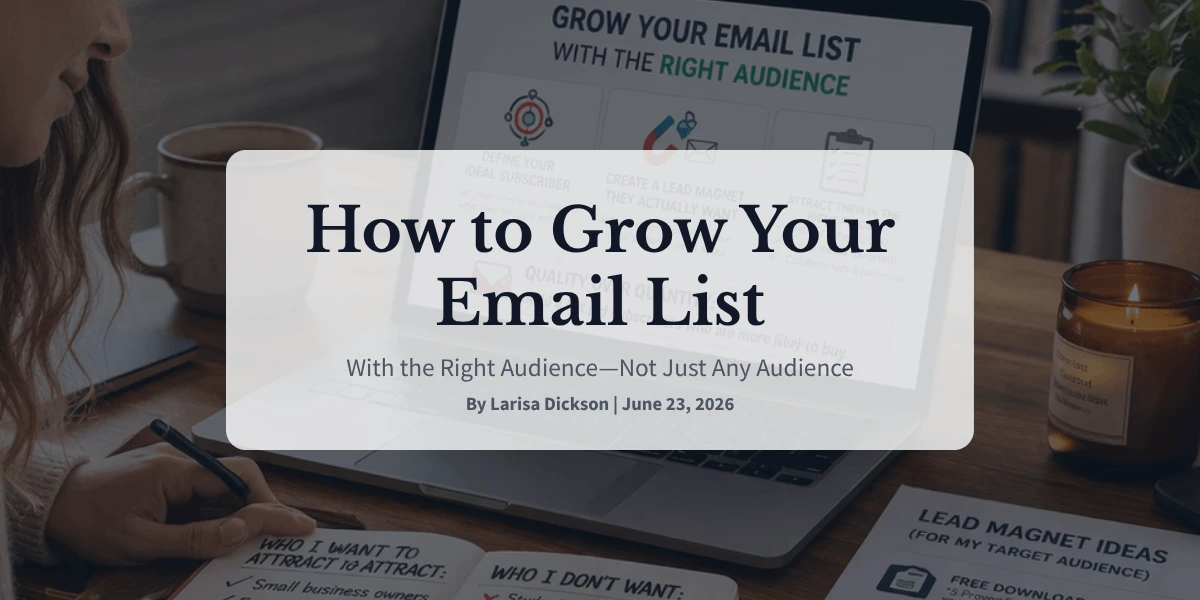
How to Grow Your Email List With the Right Audience—Not Just Any Audience
“It’s not about having the right opportunities. It’s about handling the opportunities right.” — Mark Hunter
How are things in your world? Because I want to ask you a question that might rearrange how you think about your email list.
If you emailed your list right now with an offer—a paid service, a course, a consultation—what percentage of those people would even consider buying? Be honest. If the answer makes you uncomfortable, you don’t have a list-size problem. You have a list-quality problem.
Growing an email list is easy. Anybody can throw up a generic freebie and rack up subscribers. But growing a list of the right people—people who actually need what you sell, who can afford it, and who trust you enough to buy—that takes a completely different approach. And it’s the only approach that puts money in your bank account.
I’m going to show you how to stop growing for the sake of growing and start building a list that’s loaded with your ideal client. The kind of list where every new subscriber is a potential sale, not just a number.
The Wrong Audience Got On Your List Because You Invited Them
This is going to be direct, but you need to hear it: if the wrong people are on your list, it’s not their fault. It’s yours. They showed up because something in your marketing told them to.
When your messaging is broad, your lead magnet is generic, and your content speaks to everyone, you attract everyone—including people who will never buy from you. They’ll happily take your free guide. They’ll even open a few emails. But when you make an offer, they disappear because they were never in the market for what you’re selling. They were in the market for free stuff.
The Story of a List That Looked Great on Paper
I worked with a client named Jasmine K. who ran an online fitness coaching business. She had built her email list to around eighteen hundred subscribers using a free “7-Day Smoothie Challenge.” The numbers looked impressive. Open rates were decent. She felt good about it.
Then she launched her signature twelve-week coaching program at two thousand dollars. She sent the launch emails to all eighteen hundred subscribers. The result? Two sales. Two. That’s a conversion rate that would make you cry.
The problem wasn’t the program. It was the list. Jasmine had attracted smoothie enthusiasts—people who wanted free recipes, not a premium coaching investment. Her lead magnet had nothing to do with her paid offer, so her list was full of people who had zero interest in the thing she was actually selling.
The agitation goes deeper than one bad launch. Jasmine had spent months creating content for that list, writing emails, building a relationship—all with the wrong people. That’s not just lost revenue. That’s lost time you can never get back.
Attract the Right Audience by Aligning Your Entry Point With Your End Point
Here’s the principle that changes everything: your lead magnet should be the logical first step toward your paid offer. Not a random freebie. Not something tangentially related. A direct stepping stone that solves a small piece of the bigger problem your paid service addresses.
The Alignment Formula
Think about it this way. If your paid offer helps overwhelmed small business owners get their finances organized, your lead magnet should address a specific slice of that problem—like a checklist of receipts they need to keep or a template for tracking monthly expenses. The person who downloads that checklist is already experiencing the exact pain your paid offer solves. They’re pre-qualified before they ever hit subscribe.
Cash is king, and alignment between your free content and your paid offer is what protects your revenue. When the people joining your list are already experiencing the problem you get paid to solve, selling becomes a natural conversation instead of an uphill battle.
Compare that to a lead magnet that has nothing to do with your offer. You’re filling a room with people who came for the appetizers and aren’t interested in the entrée. No amount of nurturing will fix that mismatch.
How Jasmine Fixed Her List
We scrapped the smoothie challenge and created a new lead magnet: “The 5 Reasons Your Workouts Aren’t Getting Results—And What to Do Instead.” That spoke directly to frustrated women who were already investing time in fitness and not seeing a return. Exactly the person who would pay for a coaching program that guaranteed results.
Her new list grew slower—but every subscriber was the right person. When she relaunched the program three months later, she closed eleven sales from a list of just six hundred. That’s the power of alignment.
Grow Your List in the Right Rooms, Not Just the Biggest Rooms
Where you promote your list matters just as much as what you’re promoting. Most business owners default to throwing their signup link everywhere and hoping for the best. But if you’re promoting in spaces where your ideal client doesn’t hang out, you’re just collecting dead weight.
Be Strategic About Your Growth Channels
Think about where your ideal client already is. What groups are they in? What podcasts do they listen to? What events do they attend? What accounts do they follow? Those are the rooms you want to be in—not because they’re the biggest, but because they’re the most aligned.
Guest posting on a blog your ideal client reads will bring you more qualified subscribers than a viral TikTok that reaches a million people who will never buy. Collaborating with someone who serves the same audience in a different way will fill your list faster than any ad targeting a broad demographic.
Long story short—stop trying to be everywhere and start showing up in the right places. A hundred subscribers from a targeted podcast interview are worth more than a thousand from a generic Instagram giveaway.
Offline Opportunities You’re Probably Ignoring
Don’t overlook what’s right in front of you. Networking events, speaking engagements, workshops, community groups, even one-on-one conversations—every interaction with a potential ideal client is a list-building opportunity. Have your signup link ready to share. Mention your lead magnet naturally in conversation. Make it easy for people to take the next step with you.
I built my practice serving over two thousand families, and a significant portion of my growth came from face-to-face interactions where I simply said, “I have a free guide that covers exactly what we just talked about. Can I send it to you?” That’s list building at its most powerful—personal, targeted, and grounded in real connection.
Awesome things happen when you stop chasing volume and start building relationships. Your list becomes a room full of people who genuinely want to hear from you, and that room becomes the engine of your business.
Learned behaviors can be unlearned. If you’ve been measuring success by how fast your list grows, it’s time to start measuring it by how well your list converts. That shift in thinking will change everything.
Bringing It All Together
Growing your email list with the right audience comes down to three principles. First, take responsibility for who’s on your list by making sure your lead magnet filters for the right people. Second, align your free offer with your paid offer so every subscriber is a potential buyer. Third, promote your list in the spaces where your ideal client already lives.
This isn’t about growing slowly. It’s about growing smart. I’ve watched business owners with lists of a few hundred people generate more revenue than those with lists ten times larger—because their lists were full of the right people, nurtured with the right content, and presented with the right offers at the right time.
A smaller list of perfect-fit people will always outperform a massive list of strangers. Build accordingly.
Your Next Step
Here’s your action step for today. Look at your current lead magnet and ask yourself this one question: is the person who downloads this the same person who would eventually hire me? If not, it’s time to create a new one that directly connects to your paid offer.
Then look at where you’re promoting your list. Are those channels filled with your ideal clients, or are they just the biggest platforms you could find? Identify two or three spaces where your perfect audience already gathers and start showing up there with intention.
And if you need guidance, please reach out. I started my business with three hundred and fifty dollars from my dining room table, and every dollar of growth came from building relationships with the right people—not the most people. I’ll help you do the same.
Hugs, Love and Prayers,
Larisa