
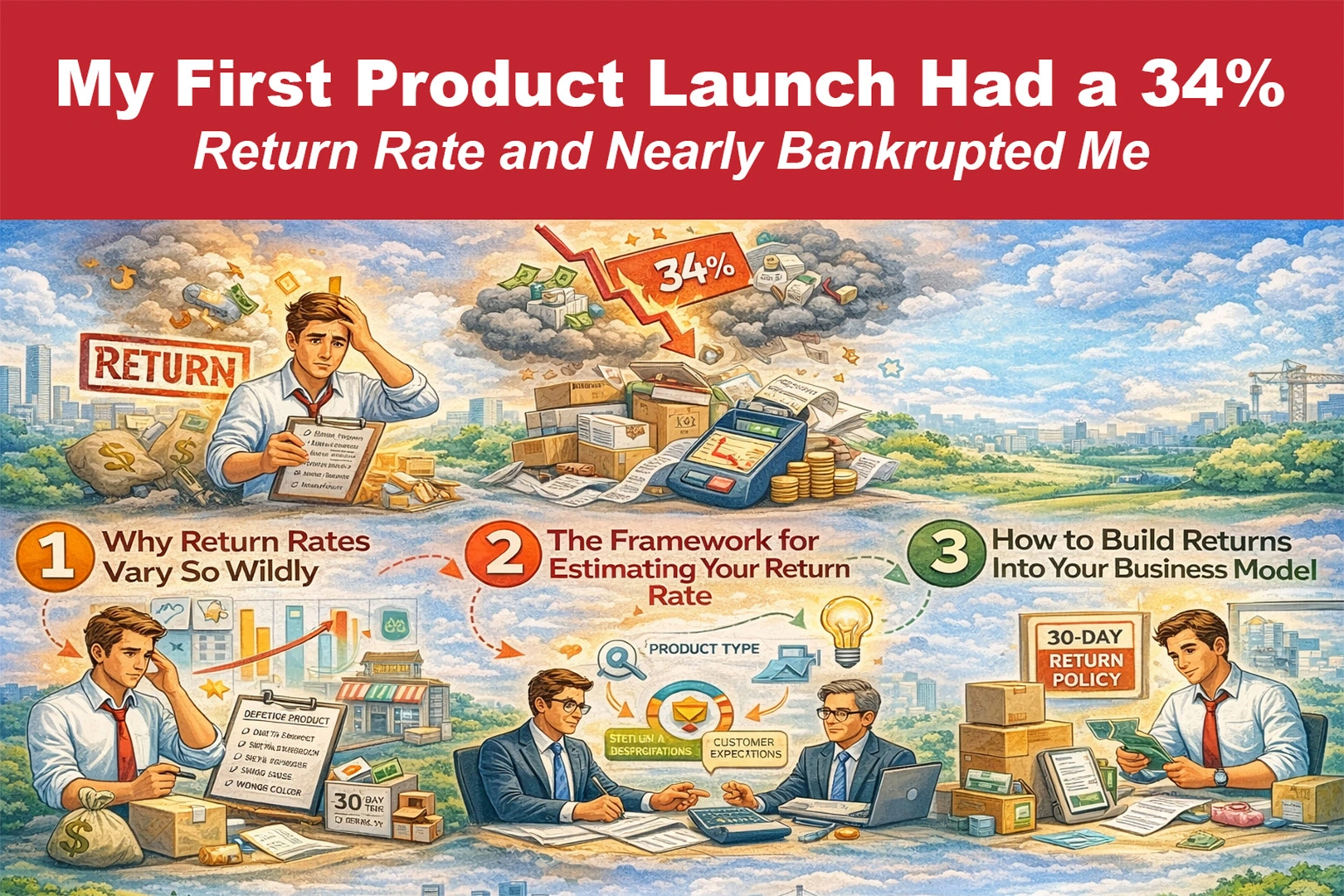
My First Product Launch Had a 34% Return Rate and Nearly Bankrupted Me
“In preparing for battle I have always found that plans are useless, but planning is indispensable.”
— Dwight D. Eisenhower
How are things in your world? Are you getting ready to launch a new product? Exciting times! But let me ask you something that could save your business: do you have any idea what your return rate is going to be? Because if you’re guessing wrong, you could be walking into a financial disaster with a smile on your face.
I’ve watched entrepreneurs pour their savings into inventory, launch with excitement, and then watch in horror as returns pile up faster than sales. The profit margin they calculated? Gone. The cash flow they counted on? Negative. All because they never planned for the reality of customers sending products back.
Long story short — I’m going to show you exactly how to estimate your return rate before you launch so you can price correctly, plan inventory wisely, and avoid the nightmare that catches so many new sellers off guard.
Derek P.’s Six-Figure Lesson
Derek P. was so proud of his new line of fitness equipment. He’d negotiated great manufacturing costs, built a beautiful website, and calculated that he’d clear forty percent profit on every sale. Life was going to be awesome.
Then reality hit.
“I budgeted for a five percent return rate,” he told me, shaking his head. “The industry average for fitness equipment is closer to fifteen percent. I had no idea.”
Within three months, returns had eaten through his entire profit margin and then some. He’d shipped products that came back damaged or “not as expected.” He’d paid for return shipping. He’d refunded customers. And much of that returned inventory couldn’t be resold at full price.
Derek lost $127,000 before he figured out how to fix his projections. Let’s make sure that doesn’t happen to you.
Why Return Rates Vary So Wildly
Not all products are created equal when it comes to returns. Here’s what affects whether customers will keep what they buy:
Product category matters most. Clothing and shoes have some of the highest return rates — often twenty to forty percent — because fit is unpredictable. Electronics run ten to fifteen percent because of compatibility issues and learning curves. Furniture and home goods can hit twenty percent because pieces look different in person than in photos.
Price point affects returns too. Higher-priced items tend to be returned more often because customers are more careful about being satisfied. A ten-dollar impulse purchase might get shoved in a drawer, but a two-hundred-dollar investment will get scrutinized.
Sales channel changes everything. Online purchases are returned at roughly three times the rate of in-store purchases. Customers can’t touch, try, or test before buying online, so they use returns as a way to evaluate.
Customer expectations are shaped by your marketing. If your photos make the product look bigger, brighter, or better than reality, expect returns when customers feel deceived. Overselling creates returns.
Seasonal timing shifts returns dramatically. Holiday purchases are often gifts, and gift returns spike in January. Launching during peak gift-buying season? Budget for higher returns.
The Framework for Estimating Your Return Rate
Here’s how to build your estimate, step by step:
Start with your industry baseline. Every product category has a typical return rate. Research yours. Clothing averages twenty to thirty percent. Electronics average ten to fifteen percent. Beauty products average five to ten percent. Home goods average fifteen to twenty percent. These are starting points, not guarantees.
Adjust for your sales channel. If you’re selling primarily online, add five to ten percentage points to your baseline. If you’re in physical retail, you might be below baseline.
Factor in your price point. Premium products generally see higher returns. If you’re selling above the category average price, bump your estimate up a few points.
Consider your return policy. Generous return policies increase returns — but they also increase sales. Restrictive policies reduce returns but may hurt conversion rates. Find your balance and adjust your estimate accordingly.
Add a buffer for the unknown. When in doubt, estimate high. It’s better to be pleasantly surprised by lower returns than devastated by higher ones.
How to Build Returns Into Your Business Model
Cash is king, which means you need to plan for returns to protect your cash flow:
Price with returns in mind. If your estimated return rate is fifteen percent, your unit economics need to account for selling only eighty-five percent of what you ship — while still covering the cost of all one hundred percent.
Reserve cash for refunds. Don’t count revenue as profit until the return window closes. Keep a reserve specifically for refunds so returns don’t create cash crunches.
Plan your inventory accordingly. If you expect fifteen percent returns, you need storage for those returns. You need processes for inspecting, restocking, or liquidating. You need staff time for handling return requests.
Track and analyze returns ruthlessly. Why are customers returning? “Changed my mind” tells you one thing. “Defective” tells you something completely different. “Not as described” means your marketing needs work.
How Derek P. Turned It Around
After that brutal first year, Derek completely rebuilt his approach. He researched return rates for comparable fitness equipment and adjusted his projections to eighteen percent — higher than average because his products were on the premium end.
He raised his prices by twelve percent to account for return costs. He improved his product photos and descriptions to set accurate expectations. He created detailed sizing guides and how-to videos to reduce “not as expected” returns.
“My return rate dropped to eleven percent,” he told me recently, “and my profit margin is actually higher now than what I originally projected. I just wish I’d done this homework before launch.”
Awesome, right? That’s what proper planning looks like.
Your Pre-Launch Checklist
Before you launch your next product, answer these questions:
What is the typical return rate for my product category? Research it. Don’t guess.
What factors might push my rate higher or lower than average? Be honest about your price point, sales channel, and customer expectations.
Have I priced my product to account for realistic returns? Run the numbers with your estimated return rate. Is the margin still there?
Do I have processes in place to handle returns efficiently? The faster you process returns, the faster you can resell or liquidate inventory.
Am I tracking return reasons to improve over time? Data is power. Collect it from day one.
Learned behaviors can be unlearned. If you’ve been ignoring return rates in your planning, today is the day to change that habit. The entrepreneurs who succeed long-term are the ones who plan for reality, not fantasy.
Go crunch your numbers. Your business depends on it.
Hugs, Love and Prayers,
Larisa