
I Wrote 87 Blog Posts Before a Single One Generated a Lead — Here's What Finally Changed
“People don’t buy what you do; they buy why you do it.”
— Simon Sinek
How are things in your world? Let me guess — you’ve been publishing blog posts, maybe even consistently, but the leads just aren’t coming. You check your analytics and see visitors trickling in, but nobody’s signing up, nobody’s reaching out, and nobody’s buying. It feels like shouting into a void.
I spent two years writing blog content that got compliments but zero conversions. “Great article!” people would say. And then they’d disappear forever. My blog was a content graveyard — lots of words, no business results.
Long story short — I’m about to show you the exact framework that transformed my blog from a vanity project into a lead-generating machine. These aren’t theories. This is what actually works when you want readers to become customers.
Brittany L.’s Conversion Breakthrough
Brittany L. is a business coach who was publishing twice a week, every week, for eighteen months. Beautiful posts. Valuable content. Professional photos. And an average of 0.3 leads per month from her blog.
“I was ready to give up on blogging entirely,” she told me. “It felt like such a waste of time. All that effort for basically nothing.”
Three months after implementing what I’m about to share with you, Brittany’s blog generates fourteen qualified leads per month. Same posting frequency. Same general topics. Completely different approach to how those posts are structured.
Let me show you what changed.
Why Most Blog Posts Never Convert
Here’s the painful truth: most business blogs are written for the wrong person. They’re written to impress peers, to sound smart, to cover topics the business owner finds interesting. But they’re not written for the actual human being who needs to be convinced to take action.
Your blog post isn’t competing with other blog posts. It’s competing with Netflix, social media, and a thousand other things demanding your reader’s attention. You have seconds — not minutes — to prove you’re worth their time.
And even if they read the whole thing, a post without a clear path forward is just entertainment. Entertainment doesn’t pay your bills.
The Framework for Posts That Actually Convert
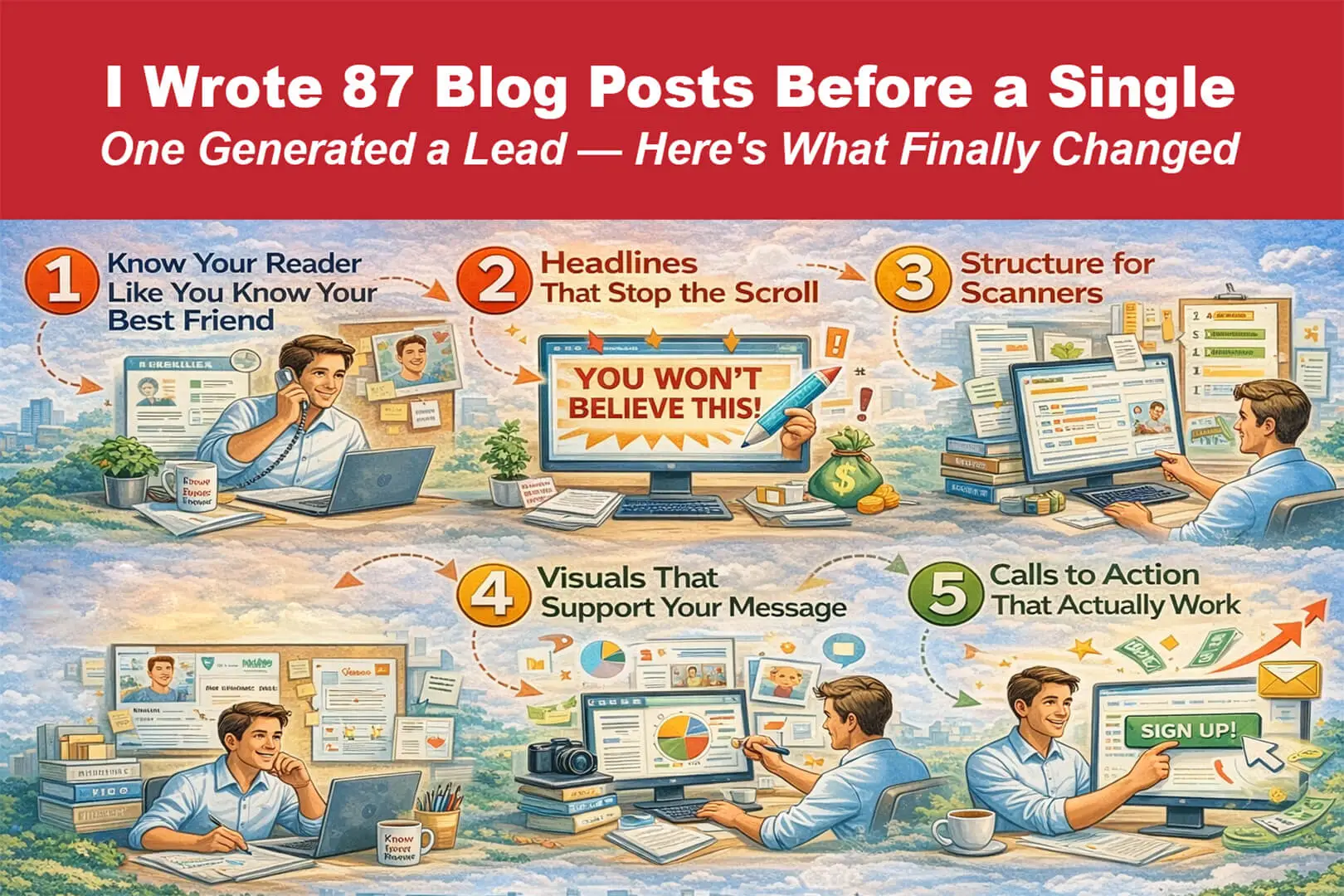
Element #1: Know Your Reader Like You Know Your Best Friend
You cannot write compelling content for “everyone.” When you try to speak to everyone, you connect with no one. Before you write a single word, you need to know exactly who you’re writing for — their fears, their frustrations, their midnight worries, their secret hopes.
What questions do they type into Google at 2 AM? What problems make them feel stuck? What would change their life if they could just figure it out? Write for THAT person. Make them feel like you’re reading their mind.
Guidance please: create a detailed profile of your ideal reader. Give them a name. Know their situation intimately. Then write every post as a letter to that one person.
Element #2: Headlines That Stop the Scroll
Your headline is the gatekeeper. If it doesn’t grab attention, nothing else matters because nobody will read past it. A boring headline on a brilliant post is a tragedy.
Great headlines promise a specific benefit or spark curiosity. They make the reader think, “I need to know more.” They often include numbers, unexpected angles, or emotional triggers.
Test your headlines before you publish. Ask yourself: would I click on this? Would I stop scrolling for this? If the answer is anything less than “absolutely,” rewrite it.
Element #3: Structure for Scanners
Nobody reads blog posts word-for-word anymore. People scan. They look for subheadings, bullet points, and bold text that tells them if this content is worth their deeper attention.
Keep paragraphs short — three to four lines maximum. Use subheadings to break up sections. Make your content visually digestible. If someone scanning your post can understand the main points in thirty seconds, they’re more likely to read the whole thing.
Element #4: Visuals That Support Your Message
Images aren’t decoration — they’re communication. The right visual can explain a concept faster than a paragraph of text. It can also create an emotional connection that words alone can’t achieve.
Use images strategically. Screenshots, graphs, photos that illustrate your points. And please, invest in quality. Stock photos of people in suits shaking hands fool no one.
Element #5: Calls to Action That Actually Work
This is where most blogs fail completely. They deliver great content and then… nothing. No direction. No next step. The reader finishes, thinks “that was nice,” and leaves forever.
Every blog post needs a clear call to action. What do you want the reader to do next? Subscribe? Download something? Book a call? Make it obvious. Make it easy. Make it compelling.
The placement of your CTA matters too. Don’t just slap it at the end. Weave relevant offers throughout the post. Use the fear of missing out — social proof that others are taking action can be incredibly persuasive.
How Brittany L. Transformed Her Results
Brittany’s first change was getting crystal clear on her ideal reader — specifically, service-based business owners in their first three years who were struggling to get consistent clients. Every post became a direct conversation with that person.
She rewrote her headlines to promise specific outcomes instead of describing topics. “5 Marketing Tips” became “How I Booked 12 Clients in 30 Days Using These 5 Simple Strategies.”
She added a valuable free download to each post — something readers actually wanted that required an email signup. And she mentioned it multiple times, not just at the end.
“The content itself didn’t change that much,” Brittany reflected. “What changed was how intentionally I designed each post to move readers toward a relationship with me.”
Awesome what happens when you stop writing to impress and start writing to convert.
Your Blog Conversion Checklist
Before you hit publish on your next post, ask yourself these questions:
Do I know exactly who this post is for and what problem it solves for them?
Would my headline make my ideal reader stop scrolling?
Can someone scanning this post understand the value in thirty seconds?
Is there a clear, compelling call to action that appears multiple times?
Am I asking for something in exchange for the value I’m providing?
Learned behaviors can be unlearned. If you’ve been blogging without conversions, you’re not bad at blogging — you’re just missing the conversion architecture. Add these elements, and watch what happens to your lead flow.
Your blog should be working for your business, not just existing on your website. Make every post count.
Hugs, Love and Prayers,
Larisa